Synthetic Organism: Nick Ervinck
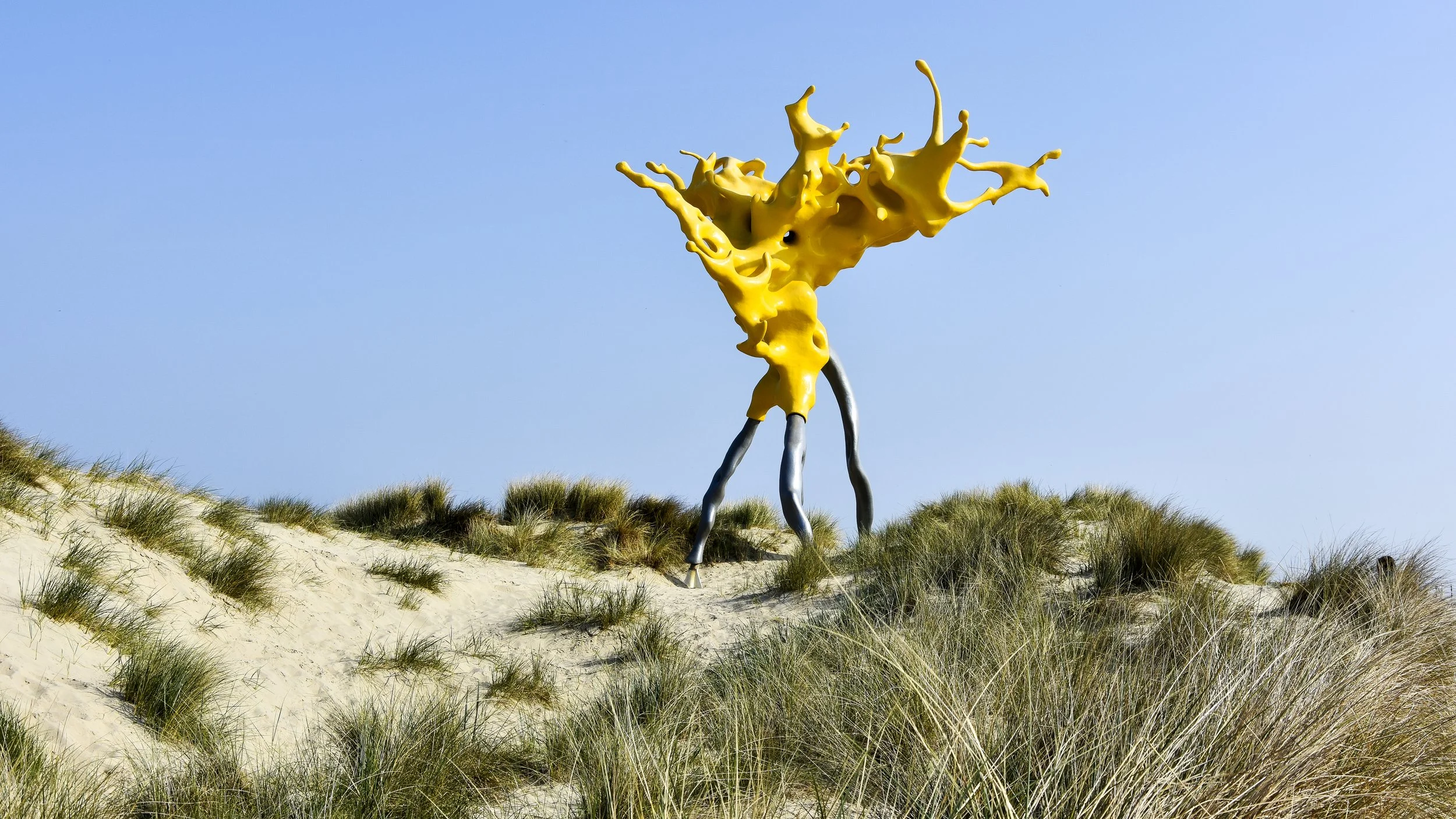
OLNETOP, Nick Ervinck, 2012.
Nick Ervinck’s OLNETOP brings together digital fabrication, speculative biology, and public sculpture. The work appears like a strange hybrid organism: part plant, part coral, part splash, part anatomical growth. Its bright yellow form rises from dark, leg-like supports, creating the impression of a creature that has emerged from the landscape but does not fully belong to it. The sculpture feels artificial and organic at the same time, occupying a space between natural growth and digital construction.
I am drawn to Ervinck’s description of his practice as a “cross-fertilization between the virtual and physical worlds.” This is useful for my own work because I am also interested in how digital processes can generate forms that feel bodily, emotional, and alive. In OLNETOP, the form does not look hand-carved in a traditional way. Instead, it carries the logic of computer modelling: smooth, complex, impossible, and almost liquid. The work suggests that digital tools can produce new kinds of organic form that could not easily exist through conventional sculptural methods.
Ervinck’s use of 3D technology is especially relevant to my research into 3D-printed bioplastics and algorithmically generated supports. He explains that 3D printing allows artists to create “new, organic, experimental, and negative spaces” and even “sculptures within sculptures.” This resonates with my interest in using digital fabrication not simply as a technical tool, but as a way of thinking through growth, support, and transformation. Like Ervinck, I am interested in how digital processes can exceed the limits of the hand and produce forms that feel biological, speculative, or mutated.
OLNETOP also helps me think about the relationship between sculpture and environment. Placed outdoors, the work appears as if it is both invading and animating the landscape. Its glossy synthetic surface contrasts strongly with the sand, grasses, and sky around it. This contrast makes the sculpture feel like an unnatural organism, but also like a possible future life-form. This is important for my own practice because I am interested in forms that blur living and non-living states.
I am also interested in Ervinck’s references to medical imagery, mutation, and technological bodies. Although OLNETOP is not directly anatomical, it shares this wider concern with transformation and artificial life. The sculpture feels like a body in the process of becoming something else: growing, opening, mutating, or adapting. This connects to my own understanding of healing as an ongoing process rather than a return to wholeness. The form does not suggest stability or completion, instead, it suggests movement, excess, and change.
I am inspired by Ervinck’s ability to make digital fabrication feel imaginative, bodily, and materially present. OLNETOP shows how technology can produce forms that are not cold or purely mechanical, but strange, energetic, and alive with possibility. His work encourages me to think more deeply about how my own digitally produced structures can become part of a sculptural language of vulnerability, mutation, support, and more-than-human transformation.
Krolik, Julia. “CREATORS – Nick Ervinck.” Art the Science, July 22, 2017. https://artthescience.com/magazine/2017/07/22/creators-nick-ervinck/
