More-than-Human Structures: Tomas Saraceno
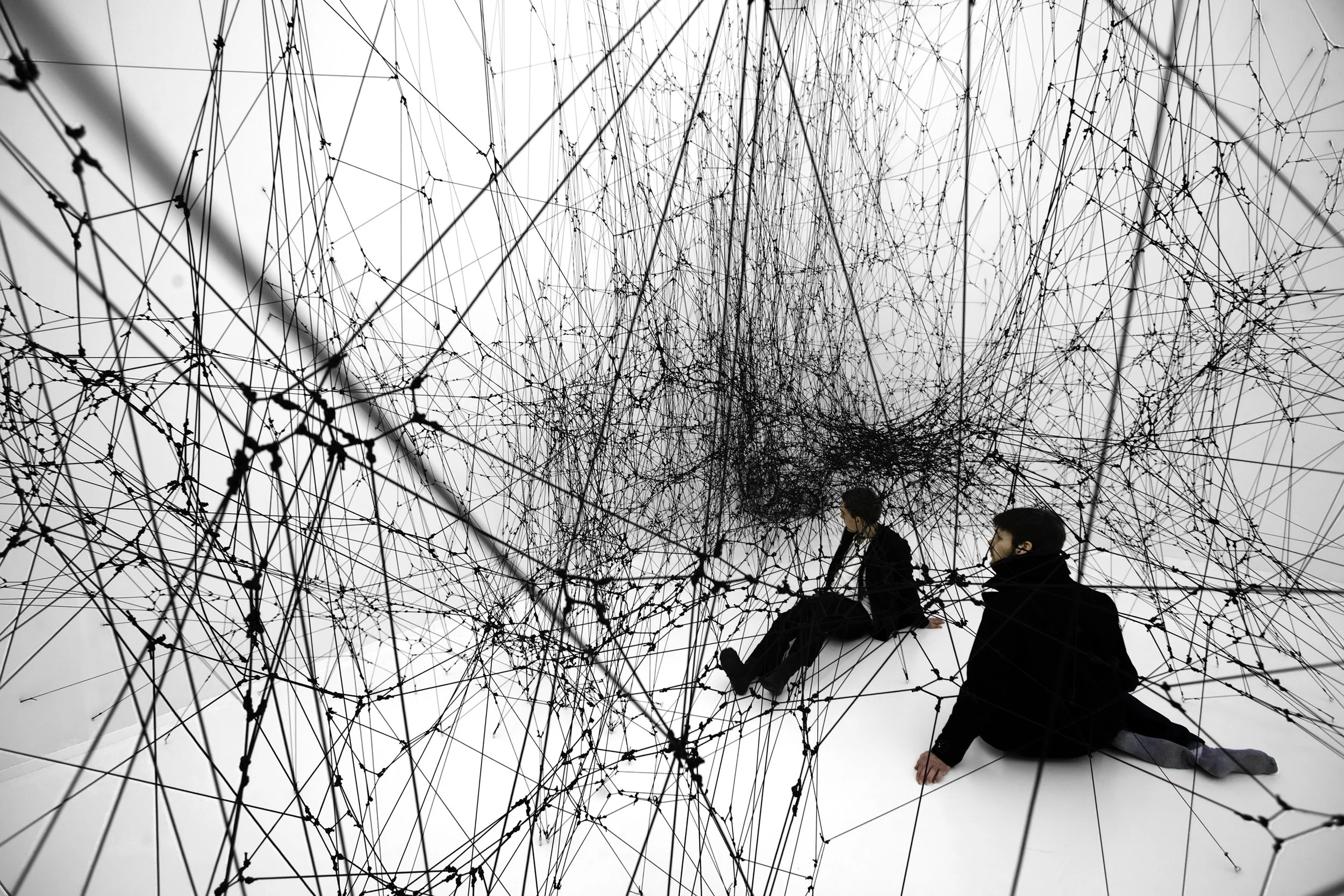
14 Billions, Tomas Saraceno, 2009.
Tomás Saraceno’s 14 Billions transforms the spider web into an immersive architectural and sculptural environment. The work expands a small biological structure into a large-scale spatial network that viewers can physically enter, making visible the complexity, fragility, and intelligence of nonhuman forms of construction. Rather than using the spider web only as a metaphor, Saraceno approaches it as a material, structural, and conceptual system. His research involved digitally capturing a three-dimensional spider web and reconstructing it at sixteen times its original size, allowing the web’s spatial logic to become bodily and architectural.
I am drawn to how the installation makes tension visible. The web is made from countless thin lines, knots, and points of connection. Each thread appears delicate, but the overall structure becomes strong through relation, distribution, and pattern. This is important to my own practice because I am interested in how vulnerable bodies are sustained through systems of support. Saraceno’s work suggests that strength does not always come from solidity or mass; it can emerge from interdependence, connection, and the careful distribution of force.
The work is also relevant to my thinking around mycelial and rhizomatic structures. Like a mycelial network, the spider web has no single centre. It spreads through space through multiple points of attachment, creating a structure that is both fragile and resilient. If one thread breaks, the entire system is affected, but the network can still continue to hold. This helps me think about healing not as a linear path toward resolution, but as a networked process shaped by tension, rupture, repair, and adaptation.
Saraceno’s collaboration with scientists and engineers is also useful for my research because it shows how art can become a site of more-than-human knowledge. In the MIT discussion, Markus Buehler explains that spider silk is not strong simply because of its material substance, but because of “the way these proteins are connected and the way they form patterns.” This idea resonates with my own material thinking. In my work, felt, internal light, 3D-printed supports, and vessel-like forms do not operate as isolated elements. Their meaning emerges through how they connect, support, wrap, illuminate, and depend on one another.
I am interested in how 14 Billions shifts the viewer’s bodily relationship to scale. A spider web, usually something small, overlooked, or even feared, becomes an environment that surrounds the human body. This reversal challenges human-centred perception. The viewer is no longer looking down at a web; they are inside its logic. This connects to my interest in creating installations that behave less like singular objects and more like habitats, where viewers encounter sculpture through movement, proximity, and sensory awareness.
14 Billions shows that a web is not only a fragile object, but a living model of relation, tension, and distributed support. His work encourages me to think more deeply about how my own sculptures can make hidden systems visible. The systems that hold wounded bodies, the networks that allow healing to continue, and the delicate structures that make survival possible.
MIT Center for Art, Science & Technology. “Reverberations: Spiders and Musical Webs.” Accessed June 1, 2026. https://arts.mit.edu/reverberations-spiders-and-musical-webs/
