Trauma as Labyrinth or Rhizome?
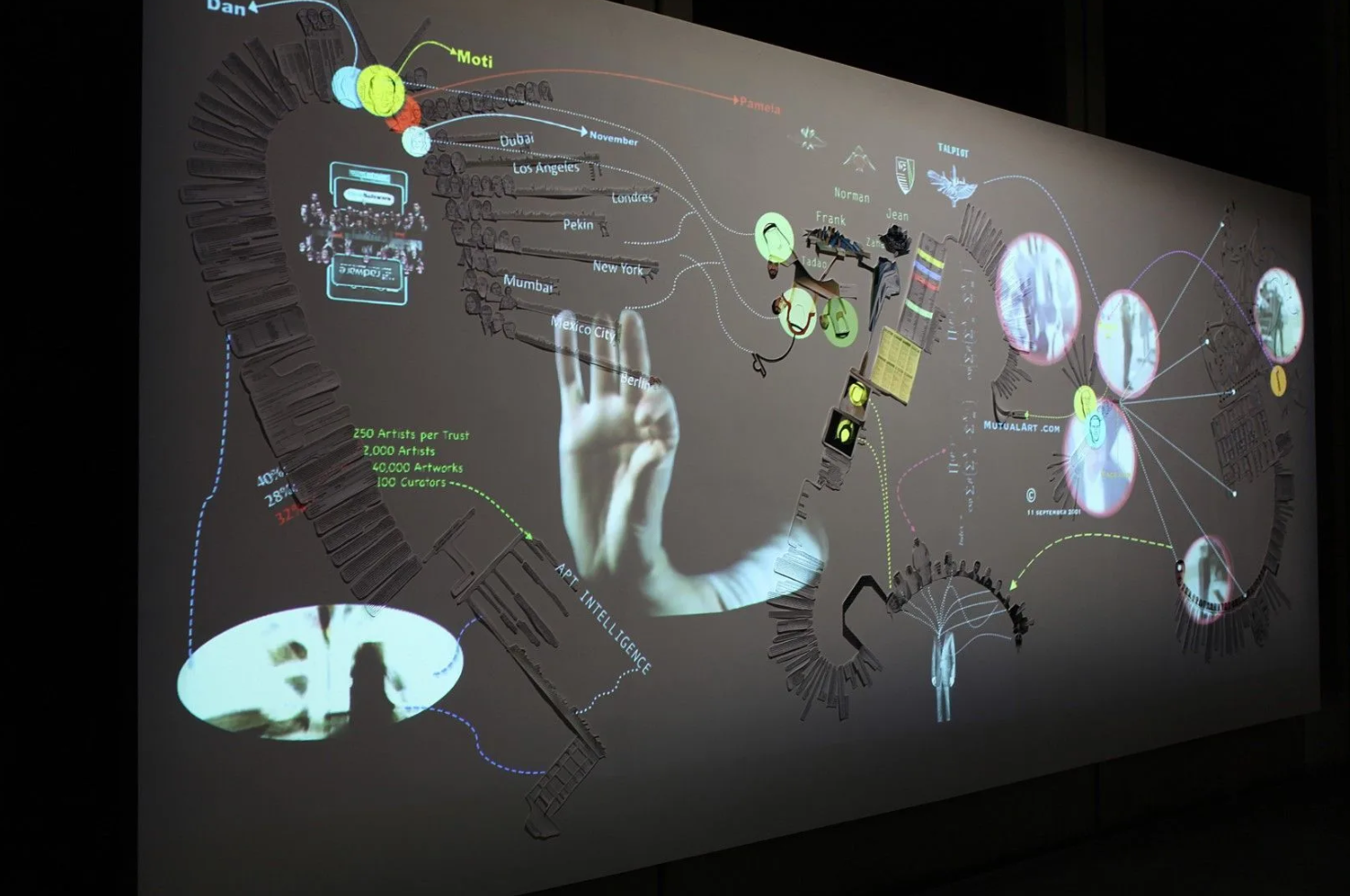
Walid Raad, Translator’s introduction: Pension art in Dubai, 2012, paper cutouts on wall, two-channel video (color, silent, looped), dimensions variable. © Walid Raad. Digital Image © 2015 The Museum of Modern Art, New York. Courtesy Paula Cooper Gallery, New York.
Reflection on Labyrinth and Rhizome: On the Work of Walid Raad by Christoph Chwatal
https://stedelijkstudies.com/journal/labyrinth-and-rhizome-on-the-work-of-walid-raad/
I find the comparison between the labyrinth and the rhizome particularly interesting. In relation to my own practice, they offer two very different ways of understanding healing from trauma, wound and pain. A labyrinth is a maze: It suggests confusion, complexity, and the possibility of getting lost. A labyrinth has a structure: an entrance, a center, and an exit. I realized that I used to think of healing more like a labyrinth, imagining it as a difficult journey towards resolution, where frustration arises from not being able to find the way out or from not arriving at a clear answer quickly enough. A rhizome, by contrast, is more like underground roots or mycelium: It has no single center, no clear beginning or end, and it spreads in multiple directions. If one part is cut, it continues elsewhere. To understand healing as a rhizome is to move away from seeing it as a maze with one answer. It does not move neatly toward closure or a stable narrative, but grows through ongoing change, relapse, adaptation and transformation.
This shift is important for my studio practice because it changes how I understand form, process, and installation. If healing is imagined as a labyrinth, the artwork may become a symbolic path: a structure that asks the viewer to move through confusion toward a final point of clarity. However, if healing is understood as rhizomatic, the artwork does not need to resolve itself. It can instead operate as a network of partial connections, repeated forms, soft attachments, ruptures, and new growths. This feels closer to how trauma and recovery are actually experienced: not as a single journey from damage to repair, but as a changing condition shaped by memory, environment, material, and relation.
Chwatal’s discussion of Walid Raad is useful here because it shows how the labyrinth and rhizome can be understood not only as spatial metaphors, but also as ways of thinking about fragmented histories, unstable narratives, and non-linear forms of knowledge. He writes that the labyrinth assumes “a point of entry, a center, and an exit,” while the rhizome offers a structure without a clear beginning or end. This distinction helps me articulate why I am less interested in making work that explains pain through a single story. Instead, I want my sculptures to hold multiple emotional and material states at once: wound, support, dependency, growth, relapse, protection, and transformation.
In this sense, the rhizome also offers a way to move beyond the idea of healing as individual self-completion. A labyrinth can still imply that the subject must find their own way out. The rhizome, however, is based on connection, discontinuity, and multiplicity. Chwatal notes that rhizomatic structures operate through “variation, expansion, conquest, capture, offshoots,” and that a fractured rhizome can continue by developing new lines. This is meaningful for my work because I am interested in healing as something distributed across bodies, materials, technologies, and environments. The wounded body does not heal alone; it is held, interrupted, extended, and reconfigured by systems around it.
This thinking directly informs my use of materials. Felt can wrap, absorb, insulate, and protect, while also suggesting skin, softness, and emotional vulnerability. Internal light creates a sense of life or warmth inside the sculptural body, but it also reveals dependence on hidden technological systems. The 3D-printed structures act as both prosthetic support and artificial growth, making visible the systems that hold the body together. Rather than treating these elements as separate components, I want them to behave like a rhizomatic network: connecting, spreading, supporting, and sometimes failing.
This also changes how I think about installation. I do not want the viewer to encounter one central object or one fixed narrative. Instead, I imagine the work as an environment of fragments and relations: vessel-like forms, illuminated interiors, soft coverings, suspended structures, and printed supports that spread through the space. The viewer may not find a single “answer” in the work, but they can experience a field of connections. This allows healing to appear as something ongoing and unfinished, rather than as a completed state.
Through the comparison between the labyrinth and the rhizome, I have begun to understand my practice less as a search for resolution and more as a process of staying with complexity. The rhizome gives me a language for thinking about trauma without forcing it into a linear narrative of damage and recovery. It allows me to approach healing as adaptive, relational, and continually becoming: a process that survives through connection, rupture, and renewal.
Chwatal, Christoph. “Labyrinth and Rhizome: On the Work of Walid Raad.” Stedelijk Studies. Accessed March 19, 2026. https://stedelijkstudies.com/journal/labyrinth-and-rhizome-on-the-work-of-walid-raad/
