Suspended System: Ernesto Neto
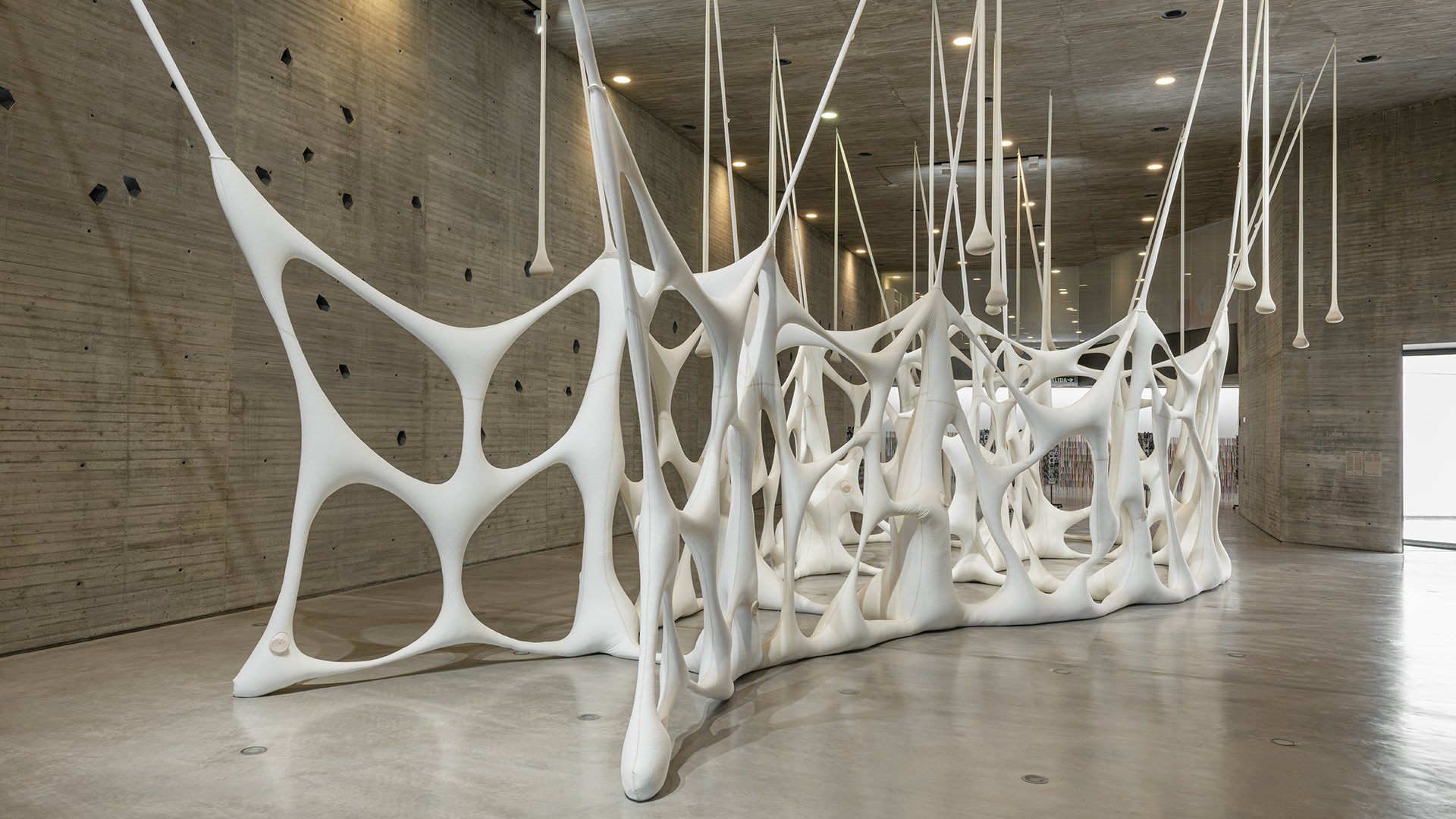
Esqueleto Glóbulos, Ernesto Neto, 2001
Polyamide fabric, styrofoam pellets, sand
450 x 400 x 1400 cm
Ernesto Neto’s work is inspiring to my practice because of the way it transforms sculpture into an environment that can be entered, felt, and experienced bodily. In this installation, the suspended white forms stretch across the architectural space like membranes, webs, organs, or connective tissue. The work does not behave like a single object placed in a room. It creates a porous spatial system that viewers encounter from within and around. I am drawn to how the soft, stretched material appears both delicate and structurally powerful, holding tension between fragility and support.
This is relevant to my own practice because I am also interested in sculpture as a bodily and relational space rather than a fixed object. Neto’s use of suspension, softness, and organic form helps me think about how materials can create a sense of being held, enclosed, or gently trapped. The work suggests care, but not in a simple or comforting way. Its web-like structure feels protective, yet it also controls movement and reorganises the viewer’s relationship to the surrounding architecture. This ambivalence connects strongly to my own interest in healing as something that can be supportive, dependent, and restrictive at the same time.
In relation to my own work, Neto’s installation encourages me to consider scale and immersion more carefully. My practice uses felt, light, 3D-printed structures, vessel-like forms, and mycelial network logic to explore vulnerability, care, and more-than-human entanglement. While Neto often works with soft, skin-like materials to create sensual and participatory environments, my own position is more focused on wounded or healing bodies and the systems that hold them together. His work inspires me to think about how an installation can become a habitat: a space where bodies, materials, supports, and viewers are all connected through tension, touch, and atmosphere.
What I take from Neto is the visual language of organic networks and the possibility of making sculpture feel alive. The suspended forms seem to breathe, stretch, droop, and respond to gravity. This helps me reflect on how my own materials might behave less like passive objects and more like active participants.
TBA21 Thyssen-Bornemisza Art Contemporary. “Ernesto Neto, Esqueleto.” Accessed April 28, 2026. https://tba21.org/esqueleto
