Home as Memory, Skin, and Displacement: Do Ho Suh
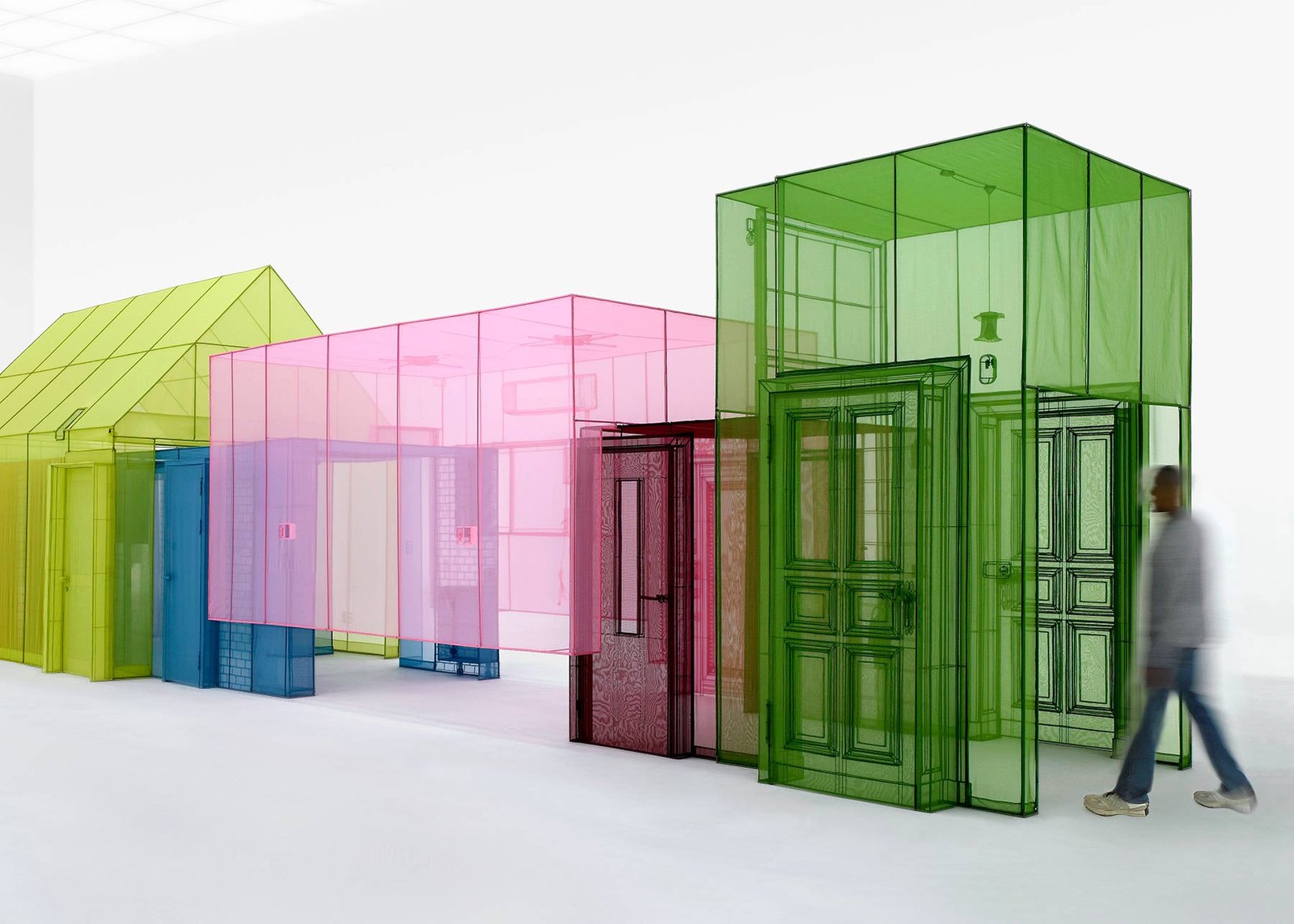
Nest/s, Do Ho Suh, 2024.
Do Ho Suh’s Nest/s transforms architecture into something fragile, translucent, and emotionally charged. Rather than presenting home as a fixed or solid structure, Suh reconstructs domestic spaces through semi-transparent fabric, creating rooms, corridors, doorways, and thresholds that appear both present and ghostly. In Nest/s, different domestic spaces from around the world are configured into a single architectural environment, suggesting that home is not one stable place, but an accumulation of memories, departures, attachments, and displacements.
I am drawn to Suh’s use of translucent fabric because it gives architecture the quality of skin. The material is delicate and almost weightless, yet it still holds the traces of walls, doors, handles, windows, and interiors. Suh describes this material approach as a way of giving form to memory, saying that he brings “a skin, the thin skin of the bigger physical thing,” and that the fragility and haziness of the fabric relate to the intangible quality of memory. This is especially relevant to my own practice, where I am interested in how materials can hold emotional residue, bodily memory, and vulnerable states without becoming fully solid or fixed.
Suh’s work also helps me think about home as something psychological and relational rather than only architectural. His fabric spaces are not simply models of buildings; they are memory structures. They carry the emotional imprint of places he has lived in Seoul, New York, London, and elsewhere. As he explains, memory is central to his practice, and the architectural pieces are “physical, but also psychological and metaphorical.” This resonates with my own interest in healing as a process shaped by environments, attachments, and systems of support. A body does not exist separately from the spaces that hold it; it carries the traces of those spaces even after leaving them.
I am particularly interested in how Nest/s turns displacement into a spatial experience. The work suggests movement between homes, cultures, and times, but it does not present displacement only as loss. Instead, it creates a layered and portable architecture, where multiple homes can overlap and coexist. Suh connects this to the Korean phrase “walk the house,” which refers to the idea of taking one’s house when moving to another location. This idea is useful for my own research because I am also interested in forms of survival that are not based on returning to an original state. Healing, like home, may not mean going back. It may mean carrying traces forward and allowing them to form new structures of belonging.
The work also offers a way to think about softness as structural. Although Suh’s fabric houses appear fragile, they are carefully constructed through stitching, measurement, repetition, and craft. The softness of the material does not make the work weak; instead, it allows architecture to become mobile, intimate, and porous. This is important for my own use of felt, light, and 3D-printed supports. Like Suh, I am interested in how delicate materials can create structures that hold memory, vulnerability, and transformation.
Suh’s work shows that the places we inhabit do not disappear when we leave them. They remain as emotional, material, and psychological traces. This encourages me to think about my own installations as environments of memory and care: spaces that are not fixed monuments, but soft, porous structures through which vulnerability, displacement, and healing can be felt.
O’Hagan, Sean. “The Internationally Renowned South Korean’s Diaphanous Houses, Coming to Tate Modern, Embody the Emotional Imprint of Where He Has Lived.” The Guardian, April 13, 2025. https://www.theguardian.com/artanddesign/2025/apr/13/do-ho-suh-walk-the-house-tate-modern-interview
