Desire Lines: Igshaan Adams
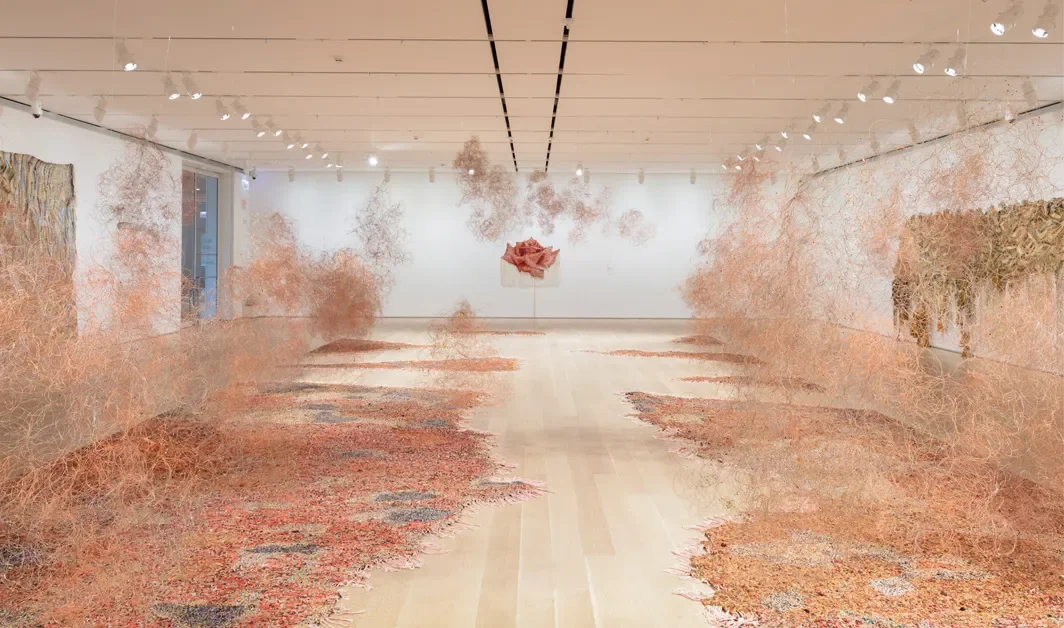
Desire Lines, Igshaan Adams, 2022, Art Institute of Chicago. Floor and hanging: Epping II, 2021. Walls, from left: Upheaved, 2018; Al-Muhyee (The Giver of Life), 2020; I was a hidden treasure, then I wanted to be known . . . , 2016.
Igshaan Adams’ Desire Lines transforms weaving into an expanded spatial and emotional environment. The installation does not behave like a single artwork placed in a room; instead, it spreads across the floor, walls, and air, creating a field of suspended threads, woven surfaces, and delicate material traces. The title Desire Lines suggests the informal paths made by repeated bodily movement, such as shortcuts worn into grass or ground. In Adams’ work, these lines become both physical and metaphorical: they speak of movement, memory, longing, history, and the paths created by lived experience.
I am drawn to how the installation uses thread as a material of connection. The hanging forms appear fragile and atmospheric, almost like dust, smoke, hair, roots, or mycelial networks. They create a sense of something in-between: not fully solid, not fully disappearing. This is relevant to my own interest in porous and relational forms, where sculpture is not only an object but a network of attachments, tensions, and traces. Adams’ work helps me think about how material can hold invisible histories, including bodily movement, emotional residue, and spiritual or social relations.
The floor-based woven works are also important because they suggest maps, terrains, or accumulated pathways. They feel like landscapes shaped by repeated gestures. This connects to my own thinking around healing as a rhizomatic process rather than a linear journey. Like a desire line, healing may not follow an official or predetermined path. It may emerge through repeated movement, small adaptations, detours, and the body’s own need to find a way through. Adams’ installation gives form to this kind of non-linear movement, where memory and desire leave material traces over time.
I am especially interested in the tension between delicacy and density in this work. From a distance, the installation feels light and atmospheric, but on closer viewing it is built through labour-intensive processes of weaving, knotting, threading, and accumulation. This balance between fragility and endurance resonates with my own use of felt. I am interested in how soft or fragile materials can still carry strength through connection, repetition, and support.
Adams’ work also helps me think about installation as an environment rather than a collection of separate objects. The suspended threads, floor pieces, and wall works create a space that viewers move through bodily. The work is not only seen; it is encountered through proximity, scale, atmosphere, and movement. This is useful for my own practice because I want my installations to operate as sensory ecosystems, where objects, viewers, materials, light, and space affect one another.
Desire Lines shows how sculpture and textile can hold memory, movement, care, and longing without fixing them into a single narrative. His work encourages me to think more deeply about how material networks can express healing as something relational, accumulated, and ongoing.
Dango, Michael. “On the Art of Igshaan Adams.” Artforum. Accessed May 25, 2026. https://www.artforum.com/features/michael-dango-on-the-art-of-igshaan-adams-251854/
