Living Interfaces: Anicka Yi
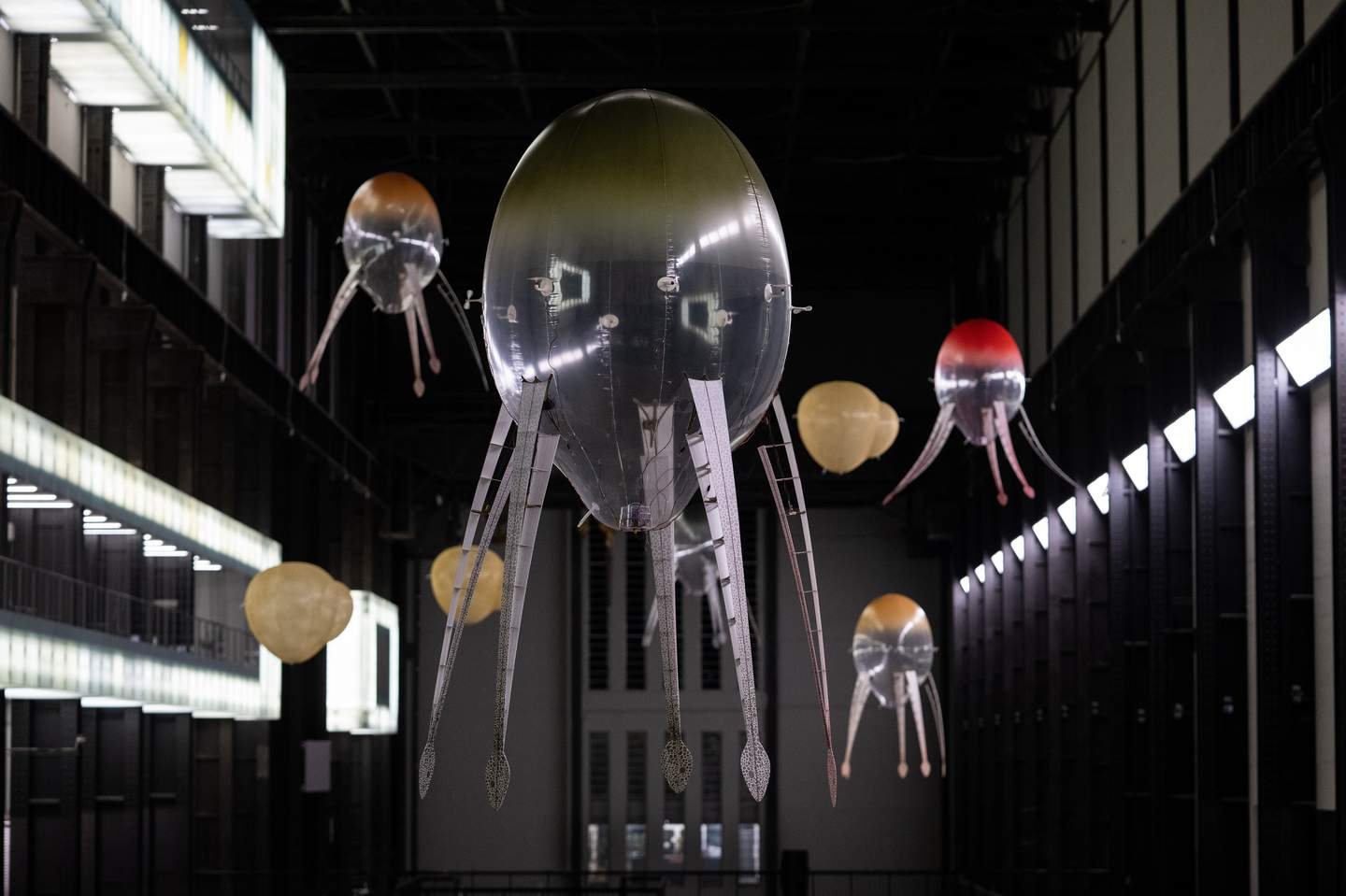
In Love With the World, Anicka Yi, 2021
Watch Anicka Yi talks about her work: https://youtu.be/lwL-9rimPc4?si=kxOt8XIwC1GloRsI
I first encountered Anicka Yi’s work while researching artists who engage with biomorphic forms. I am drawn to the way her practice brings together biology, technology, scent, artificial intelligence, and atmosphere to question what forms of life, intelligence, and agency can exist within contemporary art. In In Love With the World, Yi created floating, self-navigating machines called “aerobes,” which drifted through Tate Modern’s Turbine Hall like jellyfish, spores, or airborne organisms. The work is not only visual, but also spatial, environmental, and sensory. Yi’s wider practice often uses scent, bacteria, and synthetic aromas to challenge the dominance of vision in the gallery, treating smell as a sculptural and affective material rather than as something secondary.
I am especially interested in Yi’s use of perfume and smell because scent is invisible, unstable, and deeply connected to memory, intimacy, disgust, and the body. Unlike a solid sculptural object, smell cannot be fully contained. It spreads through the space, enters the viewer’s body, and changes the atmosphere of the installation. This makes Yi’s work feel porous and relational: the boundary between artwork, environment, and viewer becomes less clear. Her use of scent also allows the work to carry emotional and cultural associations, including ideas of hygiene, contamination, attraction, and discomfort.
I am drawn to how Yi presents technology not as cold or separate from life, but as something intimate, responsive, and almost creature-like. The floating forms seem both artificial and organic: they are machines, yet they also suggest breath, softness, vulnerability, and bodily presence. This resonates with my own interest in the blurred boundary between living and non-living states. In my practice, I use felt, internal light, 3D-printed bioplastics, vessel-like forms, and mycelial network logic to explore healing as a process shaped by more-than-human relations. Yi’s work helps me think about how technological systems can become part of an emotional and ecological language, rather than simply functioning as tools.
This precedent is relevant to my research into care, support, and dependency. Yi’s aerobes occupy the space gently, but they are also dependent on complex technological systems, programming, air movement, scent design, and human maintenance. This makes the work feel alive, but also fragile and contingent. I find this important because my own sculptures also consider how wounded or vulnerable bodies are sustained by systems that are often hidden: medical, technological, emotional, and environmental supports. Yi’s work encourages me to think of support not as something outside the body, but as something entangled with it.
While Yi’s practice often engages with artificial intelligence, scent, bacteria, and speculative forms of life, my own work is more materially focused on felt, light, 3D printing, and sculptural installation. However, we share an interest in nonhuman agency and in challenging the idea that the human body is separate from its environment. Her work inspires me to consider how my own installations might behave more like ecosystems or living interfaces: spaces where objects, viewers, technologies, smells, and atmospheres affect one another.
Tate. “Hyundai Commission: Anicka Yi: In Love With the World.” Tate. Accessed May 1, 2026. https://www.tate.org.uk/whats-on/tate-modern/hyundai-commission-anicka-yi
