Somatic Sculpture: Eva Fàbregas
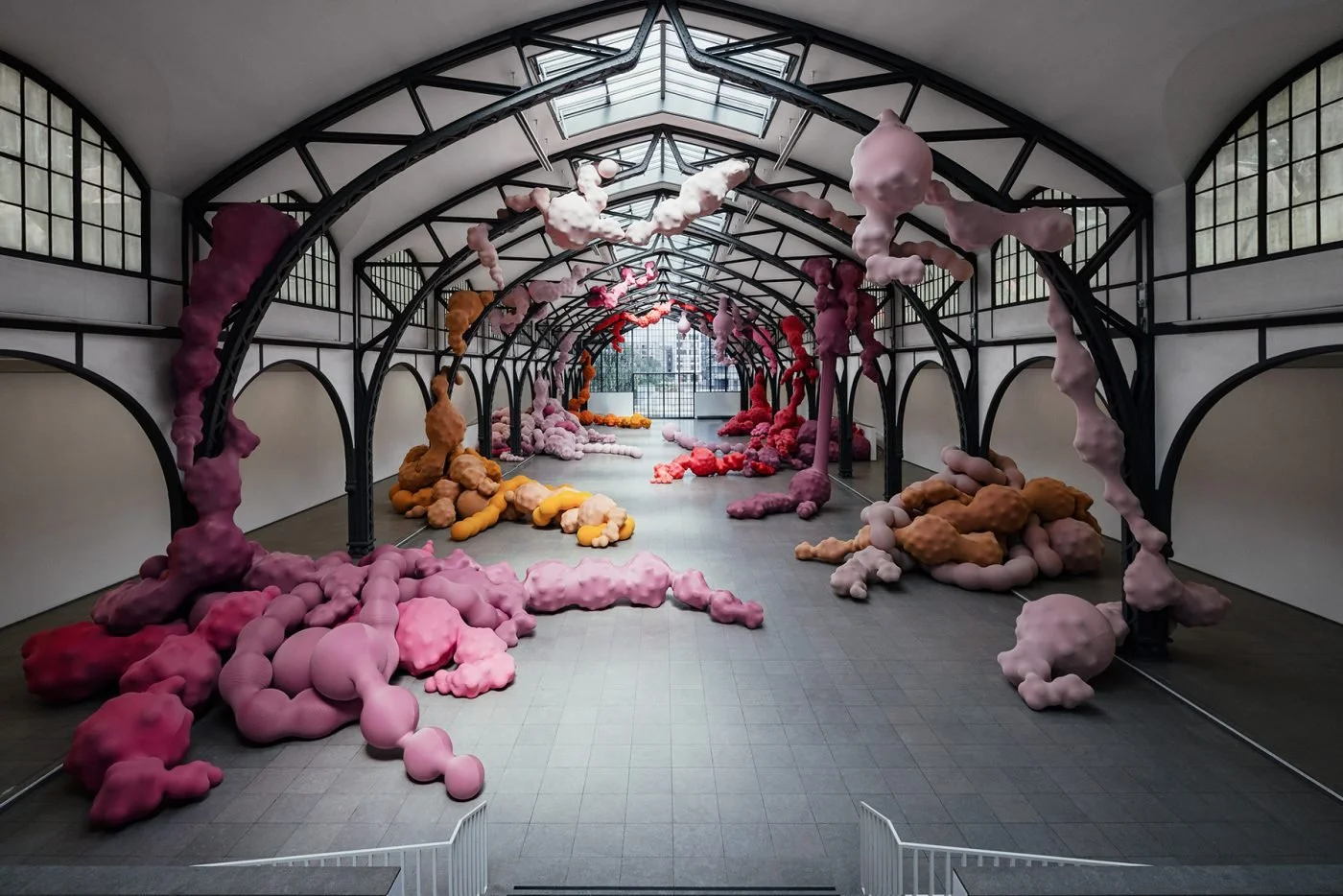
Devouring Lovers, Eva Fàbregas, Installation at Hamburger Bahnhof, Berlin, 2023
Eva Fàbregas works with soft, malleable, and sensorial materials to create sculptural environments that feel bodily, intimate, and alive. Her forms often resemble organs, glands, prosthetics, corals, polyps, or reproductive structures, yet they do not represent the body in a literal way. Instead, they suggest alternative forms of embodiment: bodies that are porous, excessive, relational, and no longer clearly separated from objects, architecture, or nonhuman life.
I am drawn to how Fàbregas uses softness and scale to create a strong physical relationship between the viewer and the work. In her installations, the sculptures spread across floors, walls, and architectural structures, appearing to grow, leak, cling, or swell into the space. The forms are playful and seductive, but also slightly unsettling. Their rounded surfaces and fleshy colours create a sense of pleasure and tactility, while their excessive growth also suggests pressure, dependency, and loss of control. This tension between comfort and discomfort is important to my own practice, where I am also interested in forms that appear soft, vulnerable, and creature-like, but carry more complex emotional and relational meanings.
Fàbregas’ work is relevant to my interest in touch as a form of knowledge. Her sculptures seem to ask to be felt before they are intellectually understood. They belong to the realm of the somatic: the bodily, instinctive, affective, and pre-linguistic. Rather than using sculpture only as a visual object, she creates situations where the body becomes aware of its own sensations, desires, and boundaries. This helps me think about how sculpture can communicate through texture, pressure, proximity, and atmosphere, not only through symbolic meaning.
I am also interested in how Fàbregas blurs the distinction between organic and inorganic matter. Her works often feel alive, but they are not biological organisms. They resemble body parts or nonhuman life-forms, yet they remain artificial, constructed, and material. This ambiguity resonates with my own interest in the boundary between living and non-living states. Fàbregas’ work helps me consider how artificial materials can still carry bodily, emotional, and affective force.
Her practice also expands my thinking around care, desire, and dependency. The forms in her installations often appear to need support from the architecture, while also transforming the space around them. They cling to beams, rest on the floor, hang from the ceiling, or gather in clusters. This creates a sense of mutual dependence between object and environment. For my own work, this is useful because I am interested in how vulnerable bodies are sustained by systems of support, including technological, emotional, medical, and environmental structures. Fàbregas’ installations show how support can be made visible through form, weight, softness, and spatial attachment.
Fàbregas’s work opens up a space for imagining other kinds of bodies and other ways of feeling, touching, caring, and being in relation. This is important for my practice because I also want my sculptures to exist between object and body, comfort and unease, vulnerability and growth. Her work encourages me to think more deeply about how softness, excess, tactility, and spatial occupation can create an embodied encounter with care, dependency, and transformation.
Bombon Projects. “Eva Fàbregas.” Accessed May 6, 2026. https://www.bombonprojects.com/represented/eva-fabregas/
