Speculative Forms of Care: Patricia Piccinini
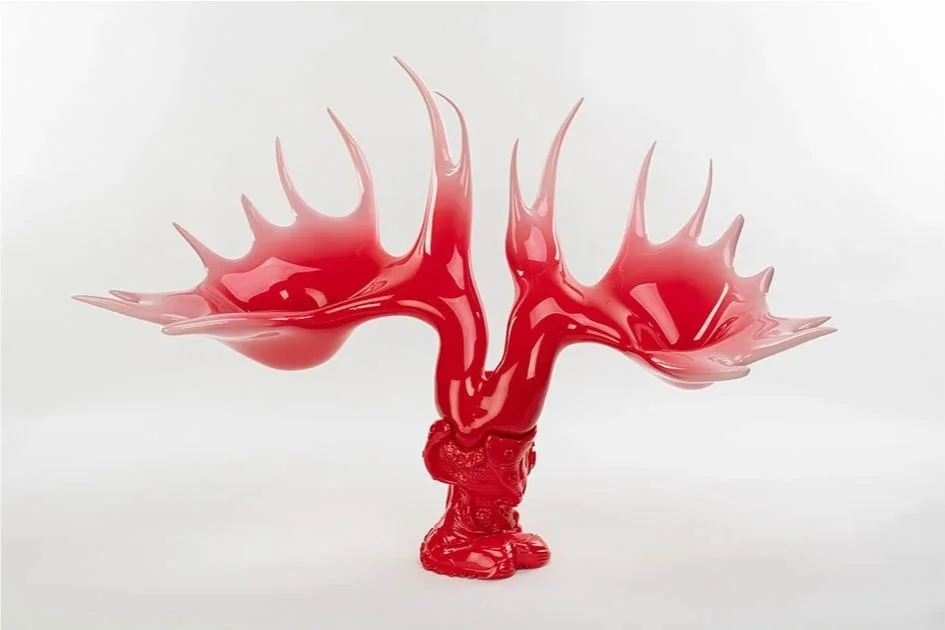
Shoeform (Ovaries), Patricia Piccinini, 2019, Resin, automotive paint
Patricia Piccinini’s Shoeform (Ovaries) transforms a familiar object into a strange, bodily, and hybrid form. The work evokes ovaries, reproductive organs, plant structures, wings, or a speculative creature. This ambiguity is central to Piccinini’s wider practice, which often questions the boundaries humans create between the artificial and the natural, the human and nonhuman, and the biological and technological. As Piccinini explains, her work has long been concerned with these “arbitrary” boundaries, especially the relationship between the artificial and the natural in medicine, science, and the environment.
I am drawn to the material and surface qualities of Shoeform (Ovaries). Made from resin and automotive paint, the sculpture has a smooth, glossy, almost wet appearance. Its red colour suggests flesh, blood, desire, fertility, and vulnerability, while its wing-like extensions feel delicate, ornamental, and slightly excessive. The work is beautiful, but also uncanny. It creates a tension between attraction and discomfort, which is important to my own interest in forms that appear soft, intimate, or seductive, while also carrying emotional unease.
Piccinini does not treat artificial life as something cold or separate from care. Instead, her hybrid forms ask ethical and emotional questions about what kinds of responsibility we have toward the beings, objects, and systems we create. In discussing Frankenstein, Piccinini describes the story not simply as a warning against scientific ambition, but as a story about failed care: Victor Frankenstein creates a new being, rejects it, and refuses responsibility for it. This idea resonates strongly with my own interest in dependency, support, and vulnerable bodies. Shoeform (Ovaries) feels like a body in formation: artificial, speculative, and not fully classifiable, yet still asking to be approached with tenderness.
The sculpture also connects to my interest in transformation and becoming. Its form appears to be opening, growing, spreading, or mutating. It does not present the body as whole, stable, or complete. Instead, it suggests a body shaped by change, relation, and uncertainty. This relates to my own practice that explores healing as an ongoing process rather than a return to wholeness. Like Piccinini’s hybrid forms, my sculptures are not intended to represent ideal bodies, but vulnerable bodies sustained by systems of support.
I am also interested in Piccinini’s idea of “speculative optimism,” which she describes as inventing hopeful narratives that allow us to imagine what the world could become, rather than simply representing what it already is. This is useful for my own research because my work also tries to hold vulnerability and hope together. I do not want to make work only about pain, damage, or wound. Instead, I am interested in how fragile, wounded, or dependent forms can still suggest care, continuation, and possible futures.
I am inspired by Piccinini’s ability to make artificial materials feel emotionally and biologically charged. Shoeform (Ovaries) holds several contradictions at once: it is organic and synthetic, beautiful and uncomfortable, intimate and strange, bodily and object-like. Her work encourages me to think more deeply about how sculpture can create empathy toward unfamiliar forms of life, and how speculative bodies can help us imagine new relationships between care, technology, vulnerability, and transformation.
Nasty Magazine. “Patricia Piccinini: Boundaries of the Unconscious.” Accessed May 9, 2026. https://www.nastymagazine.com/art-culture/patricia-piccinini-boundaries-of-the-unconscious/
