Shell, Skin, Support: Maria Bartuszová
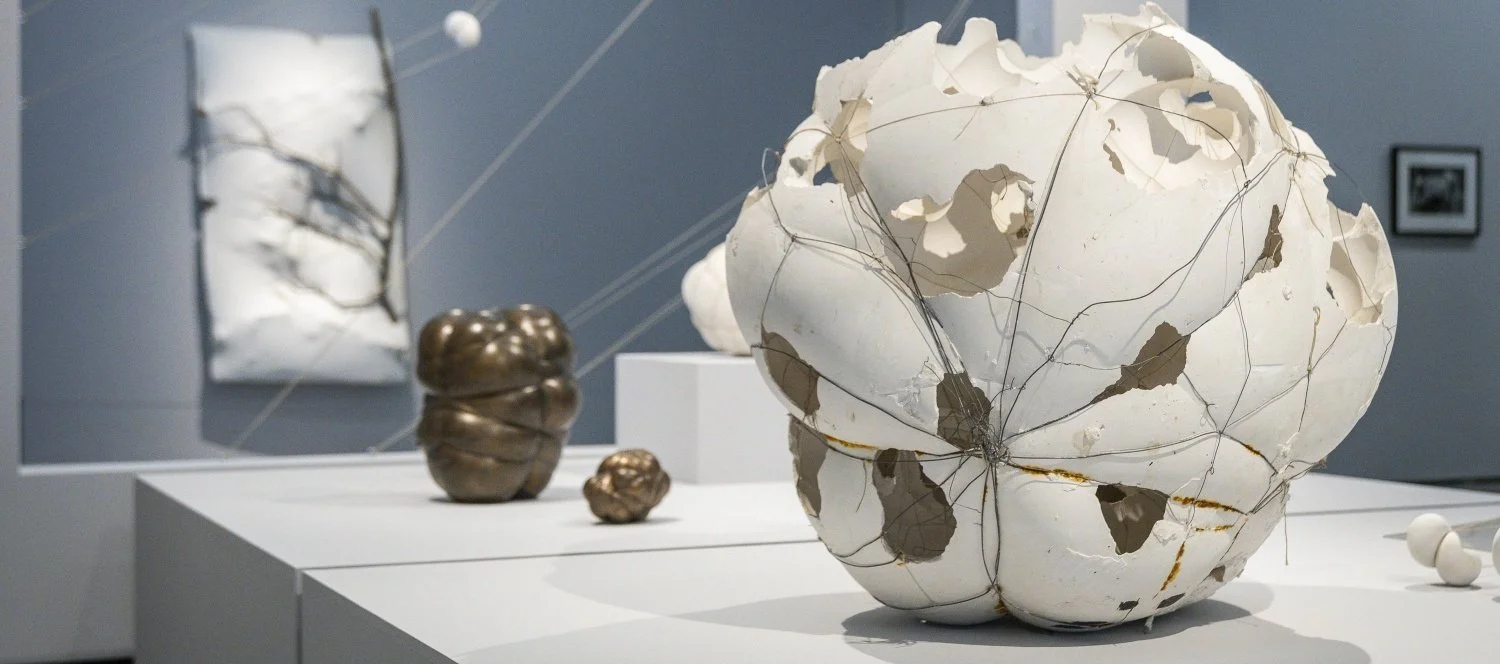
Untitled, Maria Bartuszová, 1985-1987
Maria Bartuszová’s plaster sculptures hold fragility, pressure, repair, and bodily vulnerability within a single form. The work appears like a hollow, swollen shell: delicate, cracked, and partially collapsed, yet still held together by thin lines of string or wire. Its surface suggests skin, eggshell, bone, cocoon, or a damaged vessel. Rather than presenting the body as complete or stable, Bartuszová creates a form that feels wounded, porous, and in the process of being sustained.
I am drawn to the tension between softness and breakability in this work. Although plaster is a hard material once set, Bartuszová makes it appear light, fragile, and almost breathing. The rounded form suggests organic growth, while the cracks and openings reveal its vulnerability. The string-like lines crossing the surface seem to bind, repair, support, or restrain the sculpture. This creates an emotional ambiguity: the form is being held together, but it also appears trapped by the very structures that support it.
This is relevant to my own interest in healing as an ongoing and relational process. Bartuszová’s sculpture does not suggest complete repair or return to wholeness. Instead, it makes visible a state of damage that continues to exist alongside care. The work feels as though it has survived pressure, rupture, and collapse, but only through a fragile system of attachments. This connects to my own use of felt, internal light, 3D-printed supports, and vessel-like forms to explore how wounded bodies are sustained by external systems: emotional, technological, material, and environmental.
Bartuszová’s work also helps me think about sculpture as a form of touch. The surface feels highly tactile, even when it cannot be physically touched. The thin plaster shell records pressure, contact, and formation, while the binding lines suggest gestures of holding and mending. The sculpture becomes a trace of bodily action: pressing, wrapping, tying, breaking, and repairing. In this sense, the work is not only an object, but also a record of process and care.
The work does not need to be monumental to have intensity. Its strength comes from its vulnerability: from the way it exposes breakage, dependency, and the need for support. This encourages me to think more deeply about how my own sculptures can remain open, damaged, and unfinished, while still carrying a sense of life, resilience, and transformation.
Parnass. “Maria Bartuszová.” Accessed May 13, 2026. https://www.parnass.at/news/maria-bartuszova
