Creature, Prosthesis, Machine: Hannah Levy
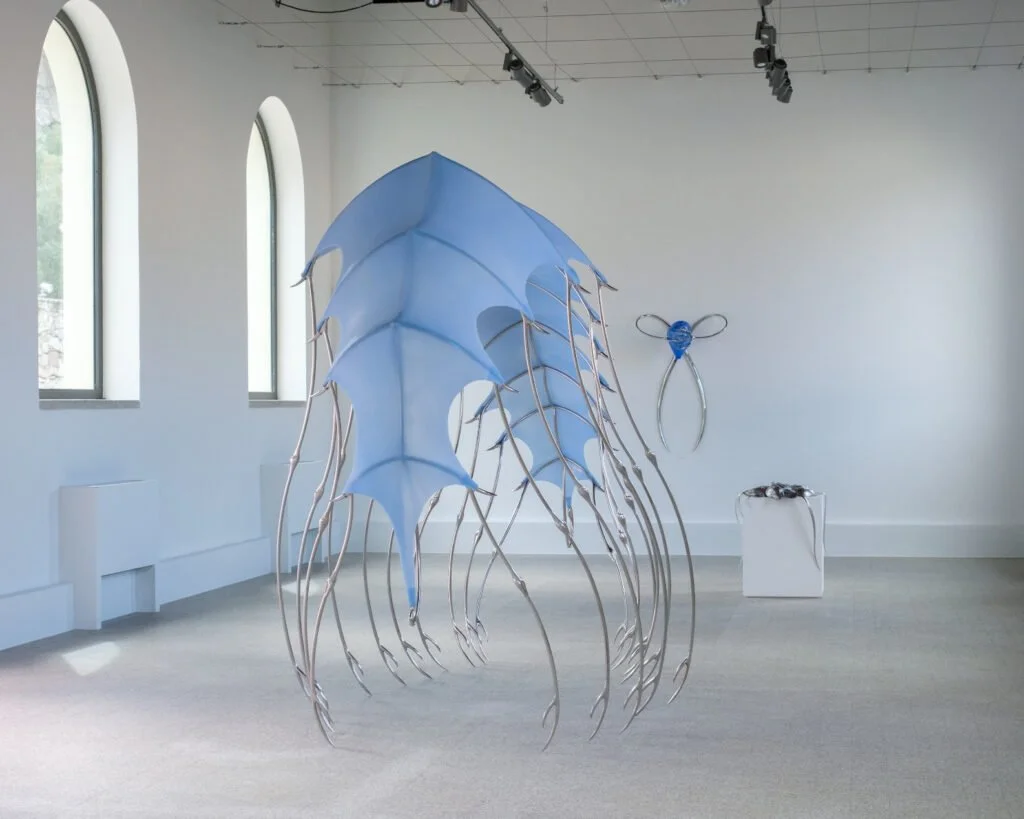
Blue Blooded / Sangue blu, Hannah Levy, 2026, Museo Nivola, Orani, Sardinia
Hannah Levy’s Blue Blooded / Sangue blu transforms bodily and biological references into a strange, elegant, and almost clinical sculptural language. The installation appears delicate and creature-like: thin metallic structures support translucent blue membrane-like forms, creating an object that resembles an insect, a wing, a shell, a medical device, or an enlarged anatomical fragment. The work does not clearly belong to the natural or artificial world. Instead, it occupies an ambiguous space between body, organism, prosthetic, furniture, and machine.
I am drawn to the tension between fragility and control in Levy’s work. The blue translucent material appears soft, stretched, and vulnerable, while the metal framework is rigid, precise, and skeletal. This contrast creates a sense that the form is both protected and exposed. It seems to need the support of the metal structure in order to hold itself open, yet the same structure also feels sharp, restrictive, and slightly threatening. This relationship between softness and hardness is important to my own practice, where I use felt and 3D-printed forms to explore how vulnerable bodies are held by external systems.
The work also interests me because it suggests the body without representing it literally. Levy’s forms often carry bodily associations through surface, tension, and material behaviour rather than through direct figuration. In Blue Blooded, the stretched blue membrane could suggest skin, wings, tissue, or organ-like transparency. The thin metal elements feel like bones, surgical instruments, or prosthetic supports. This makes the sculpture feel both sensual and uncomfortable. It attracts the viewer through its elegance and delicacy, but also produces a sense of unease through its sharpness and anatomical ambiguity.
This precedent is useful for my research into care, support, and dependency. The work appears almost alive, but its liveliness depends on constructed systems: frame, tension, balance, suspension, and material engineering. This resonates with my interest in healing as a relational and technologically mediated process. A vulnerable body does not simply heal from within; it is supported by structures around it. Levy’s work helps me think about how support can appear beautiful and violent at the same time, and how structures of care can also carry pressure, restraint, or discomfort.
I am also interested in the way Levy’s installation activates space. The main form does not sit passively as an isolated object. It extends outward through thin lines, limbs, shadows, and repeated forms, creating a bodily atmosphere within the gallery. The work feels like part of a larger ecosystem of strange, hybrid objects. This connects to my own aim to create installations that behave less like single sculptures and more like environments, where materials, light, forms, and viewers enter into relation.
Blue Blooded shows how material contrast can produce emotional complexity: softness against metal, vulnerability against structure, elegance against threat. Her work encourages me to think more carefully about how my own sculptures can hold contradictory feelings, especially care and discomfort, protection and exposure, bodily intimacy and technological support.
mother’s tankstation. “Hannah Levy.” Accessed May 18, 2026. https://www.motherstankstation.com/library/hannah-levy/
